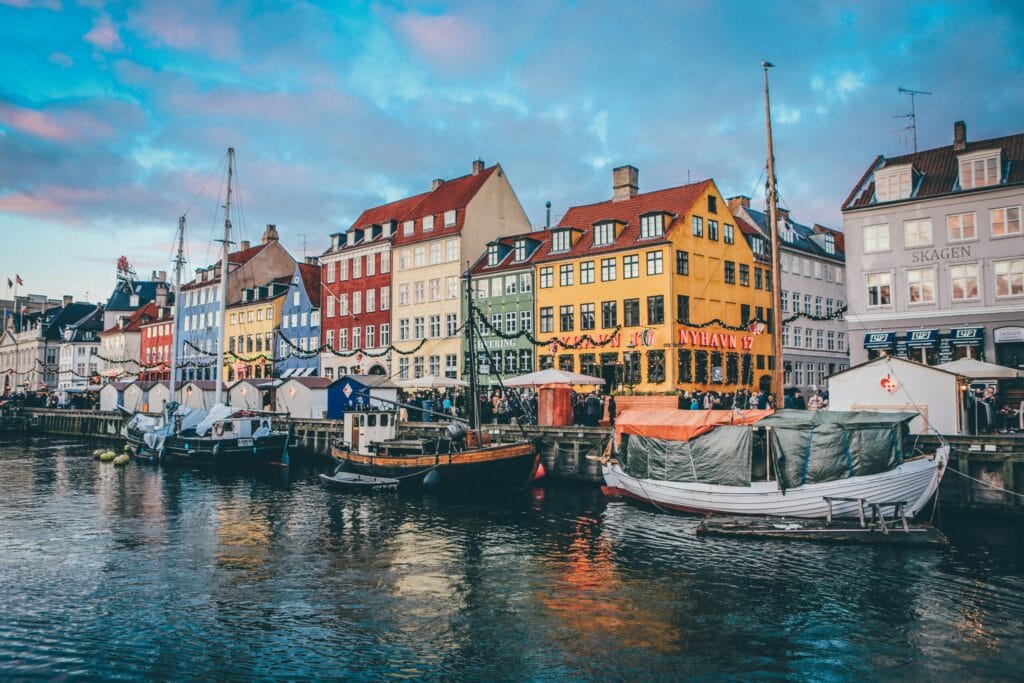
If you’re seeking online English therapy in Copenhagen, you may have encountered long waiting lists, GP referral requirements, or practitioners who don’t understand expat life. I offer depth-oriented, integrative psychotherapy for professionals and internationals, delivered securely online to clients across Copenhagen and Denmark.
- ✓ No GP referral required
- ✓ No insurance paperwork
- ✓ Immediate access—no quotas or waiting lists
- ✓ Sessions in English, fully confidential
The Hidden Struggle of International Life in Copenhagen
The Happiness Paradox
Denmark consistently ranks as one of the world’s happiest countries. Yet many international residents report feeling isolated, misunderstood, or depressed—creating a dissonance that intensifies shame and self-doubt. When everyone around you seems to be living the dream, struggling can feel like a private failure.
Janteloven & Social Reserve
The unwritten cultural norm of Janteloven—modesty, equality, not standing out—can make Danes appear emotionally distant. Building genuine connections often takes years, leaving newcomers caught between a slow-to-open Danish social world and a transient expat bubble. The result is a particular kind of loneliness: surrounded by people, yet unseen.
Healthcare System Barriers
Public psychotherapy requires a GP referral—and is only available for 11 specific diagnostic criteria. Quotas fill quickly, especially for depression and anxiety, resulting in waiting lists that can stretch months into winter. If your struggle doesn’t fit a diagnostic box, or if you simply want to work preventatively before things escalate, the public system has little to offer.
Premium Private Costs
Private therapy in Copenhagen typically costs DKK 1,125–2,846 per session (≈€150–€380). Many English-speaking practitioners add further premiums for expat-focused services, placing sustained, depth-oriented therapy out of reach for most.
If you’re navigating culture shock, burnout, existential questioning, or the pain of exclusion—you’re not alone. These are common experiences for those living between cultures, and they deserve more than quick-fix solutions. For a deeper evidence-based understanding of expat mental health — including burnout profiles, crossover stress in couples, and the science of adjustment — see our Expat Mental Health Resource Guide
My Approach: Three Calls to Wisdom
Unlike conventional CBT or symptom-focused therapy, my practice is built on an integrated framework combining Western philosophy, depth psychology, and contemplative traditions. This is transformative work—not just managing distress, but fundamentally reorienting how you relate to yourself and the world.
1. Critical Self-Inquiry
Examining unexamined beliefs about happiness, success, belonging, and worth. What stories are you telling yourself about who you should be? Which assumptions about Danish or expat identity have gone untested? We use critical thinking and evidence-based inquiry to dismantle cognitive distortions and rebuild a clearer, more honest way of navigating the world.
2. Deep Emotional Connection
Working through the pain of exclusion, loneliness, identity fracture, and grief. Not suppressing difficult emotions, but sitting with them honestly until their message becomes clear. Often, the things that hurt us most lie beneath the surface—in patterns we repeat, emotions we suppress, and somatic tensions we ignore. We create a safe space for the unconscious to emerge.
3. Transpersonal Growth
Moving beyond the performative self, finding meaning beyond social validation. Discovering what it means to live authentically—not as a reflection of others’ expectations, but as your own sovereign being. Drawing on insights from stoic resilience and Buddhist non-attachment, we explore how the pursuit of wisdom is often blocked by attachment to a fixed identity.
What Makes This Different
- No pathology-first model: You don’t need a diagnosis to work with me
- No GP gatekeeping: Book directly, anytime
- Intellectual rigour: Your questions and reasoning will be respected, not dismissed
- Cross-cultural lens: I understand the specific pressures of living between cultures
Transparent Pricing: What Does Therapy Cost in Denmark?
| Provider Type | Typical Cost per Session | Access Requirements | Waiting Period |
|---|---|---|---|
| Public System (with GP referral) | ~DKK 400 (≈€54) | GP referral + specific diagnosis | Weeks to months |
| Private Copenhagen Practices | DKK 1,125–2,846 (≈€150–€380) | None (self-referral) | Days to weeks |
| Intern/Student Therapists | DKK 450–748 (≈€60–€100) | None | Varies |
| My Practice | €90 (≈DKK 670) | No referral, no diagnosis | Immediate |
Notes on Pricing
- All sessions are 50 minutes, conducted via secure video conferencing
- Sessions are €90 (≈DKK 670) for individual therapy; €105 (≈DKK 785) for couples therapy (60 minutes)
- Billing is discreet—no “therapy” label appears on statements
- First session available within 48–72 hours of enquiry
- Statements appear discretely—no clinical or diagnostic information recorded
Payment Options from Denmark
- SEPA bank transfer in EUR — Transfer €90 to my business account. Your Danish bank handles the DKK-to-EUR conversion at their standard rate. Free for both sides, typically arrives same-day.
- Invoice billing — Available on request, formatted for Danish private health insurance reimbursement if your plan covers external providers. Billing is discreet—no clinical or diagnostic information recorded.
About Danish Private Health Insurance: Some employer-linked plans (Sygesikring Danmark, DSS Sundhed, Aleris) may cover psychologist/psychotherapist sessions. Coverage varies by insurer and plan—some require a Danish-authorised psychologist, others reimburse any licensed practitioner. I can provide invoices with appropriate codes if needed. Contact me to discuss your specific plan before booking.
How Online Therapy Works from Copenhagen
No commute, no waiting rooms, no GP gatekeeping.
1. Initial Enquiry
Contact me via the form below with your availability, preferred language (English or French), and brief context about what you’re seeking.
2. Book Your First Session
Schedule directly through the secure booking portal. Payment is collected at time of booking.
3. Begin Therapy
Join via encrypted video at your scheduled time. Sessions are confidential, recorded only in clinical notes (never shared).
Confidentiality & GDPR Compliance: All communications are encrypted. Notes are stored securely under GDPR guidelines. No information is shared with third parties without your explicit consent—or unless required by law (rare, and you would be informed).
Issues We Work With
The “Three Calls” approach applies to a wide range of challenges:
- Anxiety and Overthinking: Breaking the loop of intellectualising emotion
- Burnout and Stress: Reconnecting with the body and releasing chronic tension
- Depression and Low Mood: Accessing buried affect and finding new agency
- Cultural Transition: Integrating the fractured self across cultures
- Identity and Belonging: Moving beyond the performative self toward authentic existence
- Relationship Dynamics: Opening space for the unconscious to reshape connection
- Existential Crisis: Questioning the attachment to self and finding deeper footing
This isn’t exhaustive. If you’re uncertain whether this approach fits your situation, reach out via email and I’m happy to discuss it.
Frequently Asked Questions
Is therapy free in Denmark?
Therapy can be subsidised through the public system with a GP referral—at approximately DKK 400 (~€54) per session—but access is restricted to 11 specific diagnostic criteria (mild to moderate depression, anxiety, etc.), and quotas fill quickly, especially in winter. This leaves many without affordable options until their condition worsens enough to qualify.
Private therapy (including mine) is self-funded but offers immediate access without diagnosis requirements, and deeper transformative work beyond symptom management.
How much does therapy cost in Denmark?
Private therapy in Copenhagen typically ranges from DKK 1,125–2,846 per session (≈€150–€380) for experienced practitioners, with first intake sessions sometimes higher (DKK 1,000–1,700). My rate of €90 (≈DKK 670) is significantly below market average, enabled by my online-only, lean operating model.
Student/intern therapists charge DKK 450–748 (≈€60–€100), though their training and specialisation will differ from an established practitioner.
Do I need a GP referral?
No. In the Danish public system, a GP referral is required to access subsidised psychological care. In private practice, no referral is necessary—you book directly.
This eliminates a significant barrier: some clients struggle to convince GPs they qualify for referral, while others simply want to seek help before reaching crisis point. With me, you can start whenever you choose.
Are you a psychologist in Denmark?
That’s an important distinction. In Denmark, the title “psychologist” (psykolog) is legally protected — it requires a 5-year university Master’s in psychology, 2 years of supervised practice, and state authorisation from the Danish Patient Safety Authority. I don’t hold that title.
Titles for therapists vary internationally. In France, where I am based, my regulated title is psychopraticien. In English-speaking contexts, I describe my work as psychotherapy and refer to myself as a psychotherapist — and while “psychotherapist” (psykoterapeut) isn’t a protected title in Denmark either, I hold formal qualifications (a Bachelor of Integrative Psychotherapy) and maintain ongoing supervision with senior clinical practitioners. My approach focuses on depth-oriented, philosophical work rather than the symptom-management model typical of the public system.
If you specifically require a Danish-authorised psychologist — for insurance purposes or a formal assessment — I can refer you to appropriate colleagues. If you have questions about my credentials or training, I’m glad to discuss them directly.
Is online therapy effective?
Yes. Decades of peer-reviewed research confirm that online therapy produces comparable outcomes to in-person sessions for most presentations (anxiety, depression, relationship issues, trauma processing).
Since the pandemic, Danish clinics have widely adopted video consultations. Privacy and therapeutic alliance can be maintained effectively in a virtual setting when proper protocols are followed—protocols my practice implements rigorously.
How do I pay from Denmark?
Transfer funds via SEPA bank transfer to my business account. Your Danish bank handles the DKK-to-EUR conversion — this is free for both of us and typically arrives same-day. Invoices are available on request for insurance reimbursement.
Is my session confidential?
Absolutely. Encrypted video, secure note-keeping, and discrete billing. Nothing is shared without your explicit written consent. All records are managed in compliance with GDPR.
What if we’re not a good fit?
The therapeutic relationship is the strongest predictor of positive outcomes. If after the first session you feel my approach isn’t right, I will refer you to alternatives in Denmark or elsewhere. Fit is essential for this kind of deep work.
Crisis Support in Denmark
If you’re in immediate crisis or experiencing suicidal thoughts, please contact emergency services or one of these Danish resources:
- Livslinien (Crisis Hotline): 70 201 202 — 24/7, free, confidential
- Hjælpelinjen (Røde Kors Parat): 38 202 202 — practical support and guidance (weekdays 10:00–15:00, Mon–Wed 16:00–19:00)
- Depressionsforeningen: Peer support and information
- Emergency services: 112 — medical emergencies
My practice is not a crisis service. For acute psychiatric emergencies, please contact local services directly.
Take the Next Step
Ready to begin? Contact me for an initial consultation or book your first session directly.
Serving clients across Denmark, including Copenhagen, Aarhus, Odense, and beyond. All sessions conducted in English via secure, encrypted video platforms. Based in France, compliant with GDPR standards.